

Three methods introduce how to detect Kobelco 5170 track shoes fracture
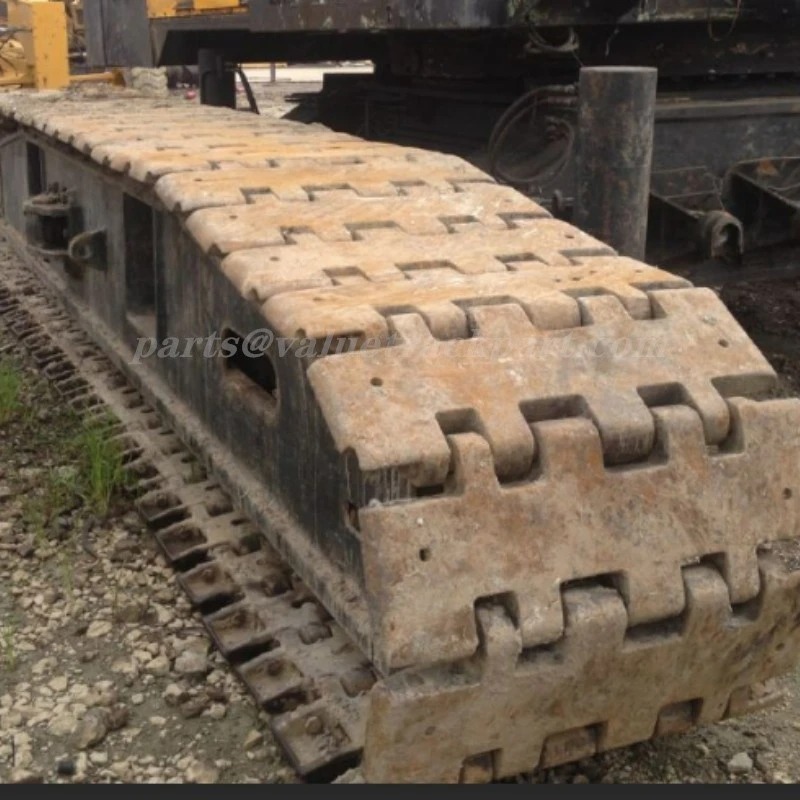
Last Wednesday, our American customer ordered a batch of Kobelco 5170 track shoes from us. The day before yesterday, our quality inspection department inspected the Kobelco 5170 track shoes for cracks, so I will take this opportunity to introduce to you how to check the track shoes Check for cracks!
1. Magnetic Particle Testing (MT)
Magnetic Particle Testing utilizes the interaction between the leakage magnetic field at the workpiece defect and the magnetic powder. It utilizes the difference between the magnetic permeability of the steel product surface and near-surface defects (such as cracks, slag inclusions, hairlines, etc.) and the magnetic permeability of steel. After magnetization The magnetic field at the discontinuity of these materials will be distorted, and a leakage magnetic field will be generated on the surface of the workpiece at the part of the magnetic flux leakage, thereby attracting the magnetic powder to form the magnetic powder accumulation at the defect – the magnetic trace, under the appropriate lighting conditions, showing the defect position and Magnetic Particle Testing is realized by observing and explaining the accumulation of these magnetic particles.
Magnetic Particle Testing is mainly to detect whether there are cracks and slag inclusions on the surface of Kobelco 5170 track shoes
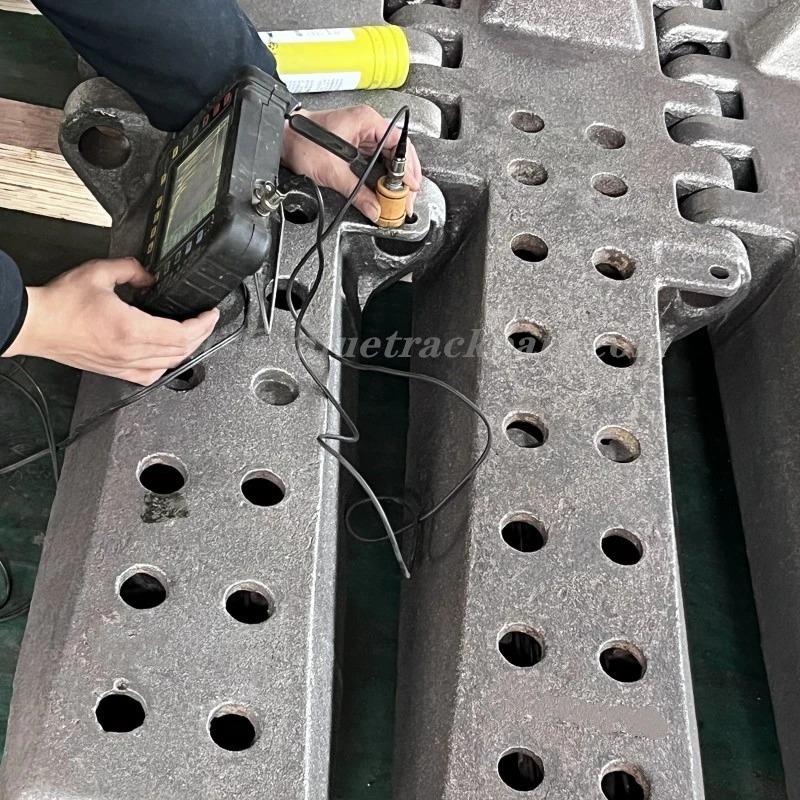
2. Ultrasonic Testing (UT)
Ultrasonic Testing uses ultrasonic waves to non-destructively inspect internal defects and scars of materials or mechanical parts. It can be inspected without damaging the interior and is one of the most common methods of inspecting the interior of a product.
When performing Ultrasonic Testing, it is necessary to apply coupling compound to the crawler crane track shoe.
The choice of couplant needs to satisfy
① The sound permeability is good, and the acoustic impedance of the coupling medium should be higher.
② There should be no corrosion on the workpiece and no influence on the subsequent process.
③ Good liquidity, convenient source and low price.
④No damage to the health of the operator.
So commonly used couplant organic oil and water
Operation: First put the ultrasonic flaw detector on the Kobelco 5170 track shoes, use the probe to move along parallel lines perpendicular to the rolling direction of the Kobelco 5170 track shoes, with an interval of 100mm, and use water or engine oil as the coupling agent for flaw detection. When the defect waveform is monitored, it should also be probed on both sides to determine the defect area, and record it on the track plate with a display pen.
Judgment of defects:
① There is no bottom pulse wave on the fluorescent screen but only multiple reflections of defect pulse waves.
② Defective pulse wave and bottom pulse wave exist on the fluorescent screen at the same time.
③Multiple disordered defect pulses with no bottom pulse but only defect pulses on the fluorescent screen
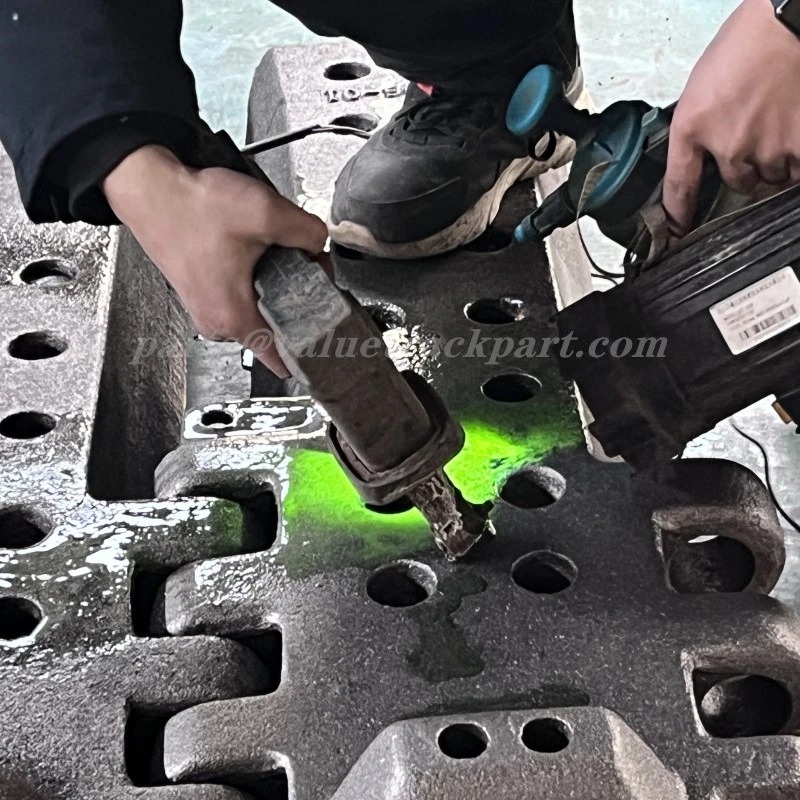
3. Penetrant Inspection (PT)
Penetrant Inspection is to apply a colored or fluorescent penetrant containing dyes on the surface of the part. Under capillary action, the penetrant penetrates into the surface opening defects due to the wetting of the liquid and capillary action. Excess penetrant on the surface of the part is then removed and a thin layer of developer is applied to the surface of the part. The penetrant in the defect is re-adsorbed to the surface of the part under capillary action to form an enlarged defect image display, and the defect display is observed under a black light (fluorescent inspection method) or a white light lamp (coloring inspection method).
The basic process of penetrant testing: penetration→cleaning→visualization→observation
Because Penetrant Inspection (PT) requires more materials, it is used less, and most of them use Magnetic Particle Testing (MT) and Ultrasonic Testing (UT)
If you want to know more knowledge, please contact:
Telephone: +86 535 671 0636
Mail: [email protected]
Website: www.valuetrackpart.com